Energy Savings with 5-Step Fan Regulators: How Much Can You Save on Electricity?
Introduction – Why Fan Speed Control Impacts Your Electricity Bill
Rising power costs in Indian homes and commercial buildings have made energy-conscious decisions more important than ever. With electricity tariffs increasing steadily across states, every appliance in your space contributes to the final bill. Ceiling fans, which run for 8-12 hours daily in most Indian households, are among the top consumers.
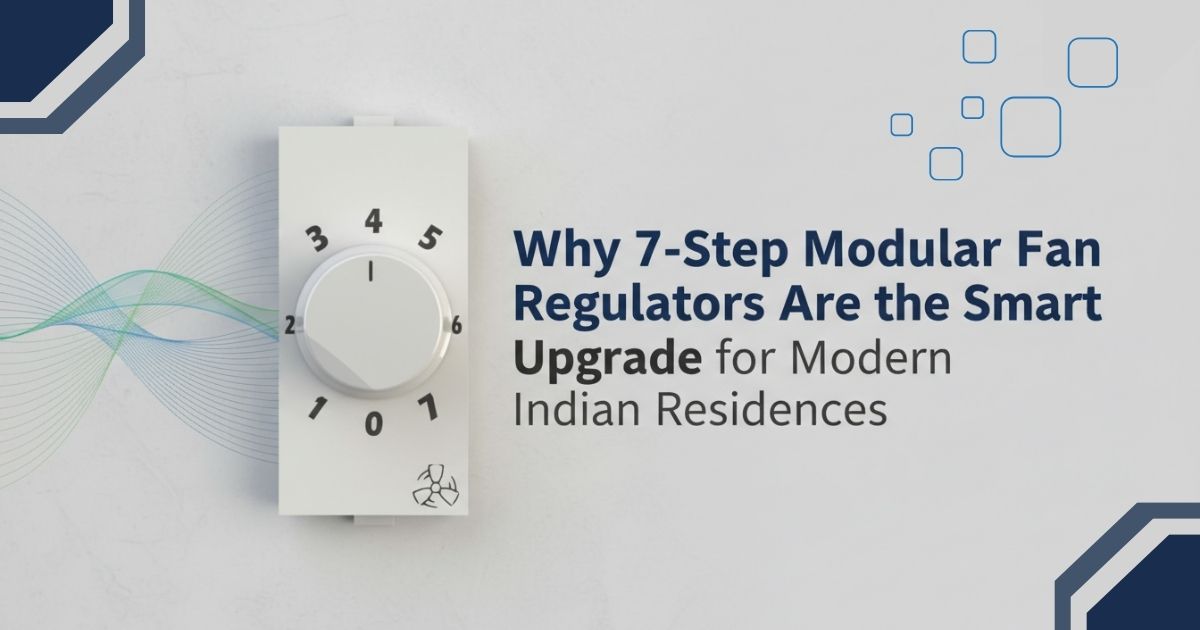
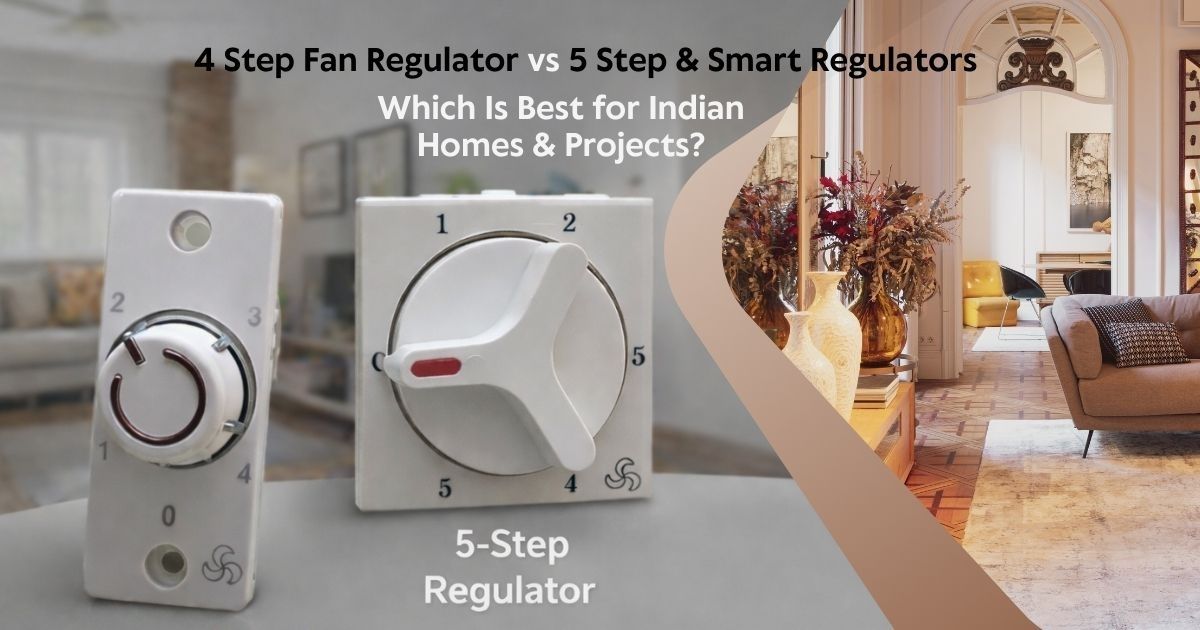
This is where a 5 step fan regulator becomes a practical energy-saving tool. Unlike outdated single-speed systems, a modern fan regulator has 5 steps allows you to adjust airflow based on actual comfort needs rather than running at maximum capacity all day. This blog will break down the real numbers how much power you consume at each speed level, what your monthly and yearly savings look like, and why choosing the right 5 Step Fan Regulator manufacturer can make a measurable difference to your electricity expenses.
How a 5 Step Fan Regulator Controls Power Consumption
A 5 speed fan regulator works by controlling the voltage supplied to your ceiling fan motor. At full capacity, the motor receives complete voltage and consumes maximum wattage. When you dial down using a 5 step fan speed controller, the regulator reduces the voltage in controlled increments, lowering both speed and power draw.
Each step corresponds to a specific voltage level. For instance, Step 1 might deliver 40% of full voltage, Step 3 around 70%, and Step 5 at 100%. This proportional reduction in voltage translates directly into reduced wattage consumption. The fan motor uses less electrical energy while still providing adequate airflow for comfort.
The key advantage over running your fan at full speed constantly is simple: you only use the power you actually need. On cooler evenings or during monsoon months, lower speeds are sufficient and they cost significantly less to operate.
Power Consumption at Each Speed Level (With Real Numbers)
Typical Ceiling Fan Wattage
A standard ceiling fan in India consumes approximately 75 watts when running at full speed. This varies slightly depending on motor quality, blade size, and design efficiency, but 75W serves as a reliable benchmark for calculations.
Watt Usage by Step
Here's how power consumption typically breaks down across a 5 step ceiling fan regulator:
- Step 1 – 30W (minimal airflow, quiet operation)
- Step 2 – 40W (gentle breeze, suitable for night use)
- Step 3 – 50W (moderate speed, ideal for spring or autumn)
- Step 4 – 60W (strong airflow, comfortable during warm days)
- Step 5 – 75W (maximum speed for peak summer heat)
These figures show that operating at Step 2 instead of Step 5 cuts your consumption nearly in half. Over months of usage, this difference compounds into substantial savings. A 5 step modular fan regulator maintains these efficiency levels consistently, unlike older resistive models that may waste energy as heat.
Monthly & Yearly Electricity Savings Calculation
Daily Usage Scenario (10 hours/day)
Let's assume your fan runs for 10 hours daily—a realistic figure for most Indian homes during summer months.
At full speed (Step 5): 75W × 10 hours = 750 watt-hours = 0.75 units per day
At moderate speed (Step 3): 50W × 10 hours = 500 watt-hours = 0.5 units per day
Daily savings: 0.25 units
Monthly Unit Consumption Comparison
Full speed usage: 0.75 units/day × 30 days = 22.5 units/month Controlled usage (Step 3 average): 0.5 units/day × 30 days = 15 units/month
Monthly savings: 7.5 units per fan
Annual Savings in ₹ (Indian tariff based example)
Assuming an average electricity rate of ₹7 per unit (varies by state and slab):
Monthly savings: 7.5 units × ₹7 = ₹52.50 per fan Annual savings: ₹52.50 × 12 = ₹630 per fan
For a home with four ceiling fans, that's ₹2,520 saved annually just by using your 5 step fan regulator intelligently. These calculations demonstrate why speed control isn't just about comfort—it's a financial decision that pays off consistently.
Seasonal Savings – Summer vs Monsoon vs Winter
Summer: Peak usage months from April to June see fans running at Steps 4-5 for extended hours. Even here, switching to Step 4 during early mornings or late evenings can trim 15-20% off your consumption compared to constant full-speed operation. Maximum savings potential exists during this period.
Monsoon: Cooler temperatures and higher humidity mean Steps 2-3 become sufficient for air circulation. Your consumption drops by 30-40% automatically. The beauty of a quality fan regulator 5 step is that it maintains smooth performance even at lower speeds without irritating humming sounds.
Winter: October through February requires minimal airflow mostly for air circulation rather than cooling. Step 1 or 2 suffices, reducing consumption to just 30-40W. While individual savings seem small, they add up over the four-month winter stretch. Consistent efficiency across seasons is what makes the investment worthwhile.
5 Step Fan Regulator vs Running Fan Always at Full Speed
Running your fan at maximum speed regardless of weather wastes significant energy. A fan motor operating at full capacity generates more heat, causes faster wear on bearings and windings, and stresses the capacitor unnecessarily.
Balanced consumption through speed control extends motor life by reducing thermal stress. Lower speeds also mean quieter operation and less vibration—benefits that improve your living environment beyond just the electricity bill.
The comfort-to-consumption ratio improves dramatically. You can maintain adequate airflow for 70-80% less cost during cooler months. Full speed should be reserved for genuinely hot conditions, not used as a default setting. Modern designs like the 2M Slim 5-Step Modular Fan Regulator are built specifically to optimize this balance with precision voltage control.
Modular vs Conventional 5 Step Fan Regulators – Which Saves More?
Older resistive regulators waste energy by converting excess voltage into heat. You've probably noticed traditional regulators becoming warm during operation that warmth represents electricity you're paying for but not using productively.
A 5 step modular fan regulator uses solid-state components that switch voltage cleanly without resistance-based losses. Efficiency improves by 10-15% compared to conventional designs. Heat generation drops significantly, and voltage steps are more precise, giving you consistent speed control.
For anyone serious about long-term savings, upgrading to modular technology makes sense. Products like the 2M Tringo 5-Step Modular Fan Regulator incorporate these efficiency improvements while maintaining durability. The initial cost difference is recovered within 2-3 years through reduced electricity consumption and longer service life.
Why Quality Matters: Choosing the Right Manufacturer
Not all fan regulators deliver the same performance. Poorly manufactured units may have inconsistent voltage steps, causing fans to hum annoyingly at lower speeds or fail to provide adequate power reduction.
Buying from an established 5 Step Regulator manufacturer in India ensures proper calibration, quality components, and adherence to safety standards. OEM 5 Step Fan Regulators undergo rigorous testing for temperature tolerance, voltage stability, and durability under continuous operation.
Consistency in speed steps directly impacts your energy savings. If Step 2 consumes 50W instead of the intended 40W due to poor manufacturing, your savings calculations fall apart. Similarly, regulators that develop issues within 1-2 years force you into replacement costs that negate any initial price advantage.
Sai Electronics India focuses on precision manufacturing to ensure each speed step performs exactly as designed. For anyone comparing options, reading our guide on How to Spot Top Fan Regulator Manufacturers Before You Shop provides useful criteria for making informed choices.
Bulk & Project Buyers – How Much Can You Save at Scale?
The savings math becomes even more compelling for commercial and residential projects. Consider an apartment complex with 200 units, each having three ceiling fans. That's 600 fans total.
Annual savings per building: 600 fans × ₹630 = ₹3,78,000
Hotels, hostels, offices, and educational institutions see similar multiplication effects. For facility managers, investing in quality regulators from a reliable 5 Step Fan Regulator supplier becomes a strategic decision that improves operational expenses year after year.
Working with a trusted wholesaler in India ensures consistent quality across bulk orders. Export-grade standards matter even for domestic installation because they guarantee performance under varying voltage conditions common in Indian electrical infrastructure. Commercial buyers should verify certifications and request performance data before finalizing large orders. The article on How Indian Cities Are Powering Up with Locally Made Fan Regulators discusses the growing trend toward domestic manufacturing that meets international quality benchmarks.
5 Step Fan Regulator Price vs Lifetime Energy Savings
A quality 5 step fan regulator price typically ranges from ₹150 to ₹400 depending on design and features. Taking the higher end at ₹400 per unit, let's calculate the payback period.
Annual savings per fan: ₹630 Regulator cost: ₹400 Payback period: 400 ÷ 630 = 7.6 months
Within eight months, the regulator pays for itself. For the remaining 9-10 years of its service life, you're enjoying pure savings. Even with conservative estimates, the return on investment exceeds 1500% over a decade.
This calculation doesn't include secondary benefits like extended fan motor life or reduced maintenance costs from operating at lower heat levels. For budget-conscious buyers, focusing solely on upfront price misses the complete financial picture. A slightly more expensive unit from a certified manufacturer delivers better long-term value through consistent performance and durability.
Whether you're purchasing from our shop or ordering in bulk, comparing lifetime costs rather than just sticker price leads to smarter decisions.
Conclusion – Small Dial, Big Savings
A simple rotary dial or switch panel can reduce your household electricity consumption by 20-40% on ceiling fan operation alone. The 5 step fan regulator remains the most cost-effective solution for Indian homes and commercial spaces because it balances comfort, control, and efficiency without requiring expensive smart home integration.
Real-world calculations show that even a single fan controlled intelligently saves ₹600+ annually. Multiply that across multiple rooms and years of service, and the impact becomes substantial. Seasonal adjustments, proper speed selection, and quality manufacturing all contribute to maximizing these savings.
For anyone looking to reduce electricity bills without sacrificing comfort, upgrading to modern modular regulators from a certified 5 Step Fan Regulator manufacturer & exporter like Sai Electronics India ensures you get precision control, durability, and measurable efficiency improvements. The technology is proven, the savings are real, and the payback period is measured in months, not years.
Make the switch, dial down when possible, and watch your electricity bills reflect the difference. For more information or bulk inquiries, feel free to contact us directly.
Blog Categories
Related Posts