If you have an older ceiling fan setup at home or in your office, there is a decent chance the regulator attached to it is wasting electricity quietly every single day. Not by a dramatic amount per fan, but across multiple rooms and over twelve months, that waste adds up to real money.
This article breaks down exactly how different regulator technologies affect your electricity bill, uses a practical monthly calculation to show the difference, and helps you decide whether upgrading to a modular fan regulator makes financial sense for your situation.
All figures used here are illustrative estimates based on typical operating conditions. Actual savings will vary depending on your specific fan, regulator model, daily usage hours, and the electricity tariff applicable in your state.
Why Does Regulator Type Affect Electricity Consumption?
To answer this, you need a basic understanding of how different regulator designs work.
Resistance-type regulators (the old wire-wound type commonly found in older homes) work by converting excess electrical energy into heat. When you set the fan to a lower speed, the regulator wastes the unused power as heat rather than sending it back to the circuit. You are paying for that wasted energy on your electricity bill every month.
Capacitor-type step regulators, including modern modular variants, work differently. Instead of burning off the unused power as heat, they use a capacitor to shift the electrical phase supplied to the fan motor. This approach wastes significantly less power at lower speed settings, meaning more of what you pay for actually goes toward running the fan.
The article on do fan regulators consume electricity at low speeds covers this mechanism in more detail if you want to go deeper into the technical side.
Understanding Regulator Power Consumption: The Numbers Behind It
Here is a simplified breakdown of how power consumption differs between regulator types under typical conditions.
A standard ceiling fan rated at 75W running continuously draws 75W at full speed. At lower speeds, the actual power drawn by the fan motor drops. However, a resistance-type regulator consumes additional wattage of its own, which does not go to the fan at all. That extra consumption is pure waste.
Typical self-consumption estimates by regulator type:
| Regulator Type |
Estimated Self-Consumption at Low Speed |
| Old resistance / wire-wound regulator |
15W to 25W wasted as heat |
| Electronic dimmer / triac-type regulator |
5W to 12W |
| Capacitor step-type modular regulator |
1W to 3W |
These figures vary by product and usage pattern. But the direction is clear: older resistance-type regulators waste more power than modern capacitor-based modular units, particularly at low and medium speed settings where fans operate for the majority of their daily running hours.
Monthly Savings Calculation: Old Regulator vs Modular Regulator
Let us work through a realistic scenario.
Assumptions:
- Fan motor rated at 75W
- Fan runs for 10 hours per day
- Electricity tariff: Rs. 7 per unit (1 unit = 1 kWh)
- Fan operates at low or medium speed for 6 of those 10 hours
- Old resistance regulator wastes approximately 20W at low/medium speed
- Modular capacitor regulator wastes approximately 2W at low/medium speed
Old Resistance Regulator:
| Parameter |
Value |
| Fan motor consumption (low speed) |
~45W |
| Regulator self-consumption (wasted) |
~20W |
| Total draw at low speed |
~65W |
| Hours at low/medium speed per day |
6 hours |
| Daily units consumed (low speed only) |
0.39 kWh |
| Monthly units (low speed portion) |
~11.7 kWh |
| Monthly cost (low speed portion) |
Rs. 81.90 |
Modular Capacitor Regulator:
| Parameter |
Value |
| Fan motor consumption (low speed) |
~45W |
| Regulator self-consumption (wasted) |
~2W |
| Total draw at low speed |
~47W |
| Hours at low/medium speed per day |
6 hours |
| Daily units consumed (low speed only) |
0.282 kWh |
| Monthly units (low speed portion) |
~8.46 kWh |
| Monthly cost (low speed portion) |
Rs. 59.22 |
Estimated monthly saving per fan: approximately Rs. 22 to Rs. 25
For a home or office with four ceiling fans running on old resistance regulators, the combined monthly saving from switching to modular capacitor regulators could reach Rs. 88 to Rs. 100. Over a full year, that is Rs. 1,000 to Rs. 1,200 per installation of four fans, which typically covers the cost of the regulators themselves within the first year.
Again, these are estimates based on the assumptions listed above. Your actual figure depends on your fan's rated wattage, daily running hours, the specific regulator models involved, and your local electricity tariff.
For a more detailed breakdown of how step-based regulators affect your bill, the article on electricity cost savings with 5-step regulators walks through additional scenarios with different usage patterns.
Old Regulator vs Modular Regulator: Full Comparison Table
| Feature |
Old Resistance Regulator |
Modular Capacitor Regulator |
| Speed control method |
Resistive (heat dissipation) |
Capacitor phase shift |
| Power wasted at low speed |
High (15W to 25W typical) |
Low (1W to 3W typical) |
| Heat generated during use |
Noticeable, warm to touch |
Minimal |
| Fan motor noise at low speed |
Often produces hum |
Generally quieter |
| Physical form |
Rotary knob, older format |
Modular, fits standard switchboards |
| Lifespan |
Degrades as wire wound ages |
Longer service life typical |
| BIS certification availability |
Rare in older units |
Available in certified products |
| Monthly electricity cost |
Higher |
Lower |
How Many Speed Steps Do You Actually Need?
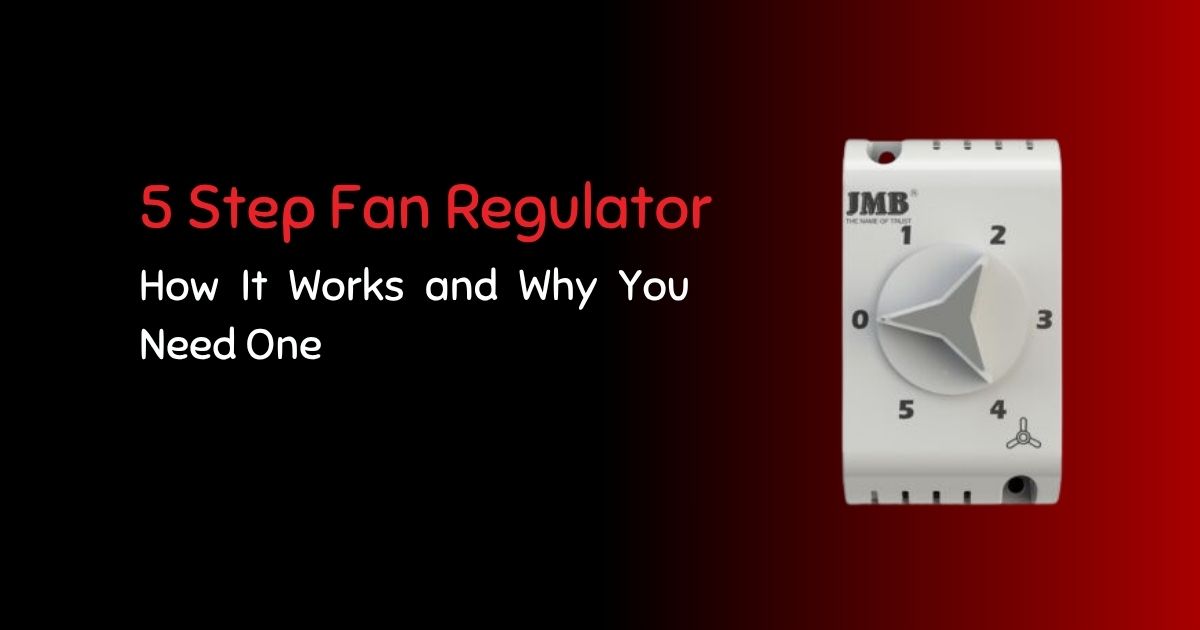
The number of steps matters more than most buyers realise. An older resistance regulator typically offers continuous or poorly defined speed adjustment. Modern modular options come in 4-step, 5-step, and 7-step configurations, each giving a distinct and repeatable speed level.
For most residential rooms, a 4-step or 5-step modular regulator provides enough granularity. If you want more precise control, particularly in bedrooms where low-speed comfort matters, a 7-step option gives finer adjustment.
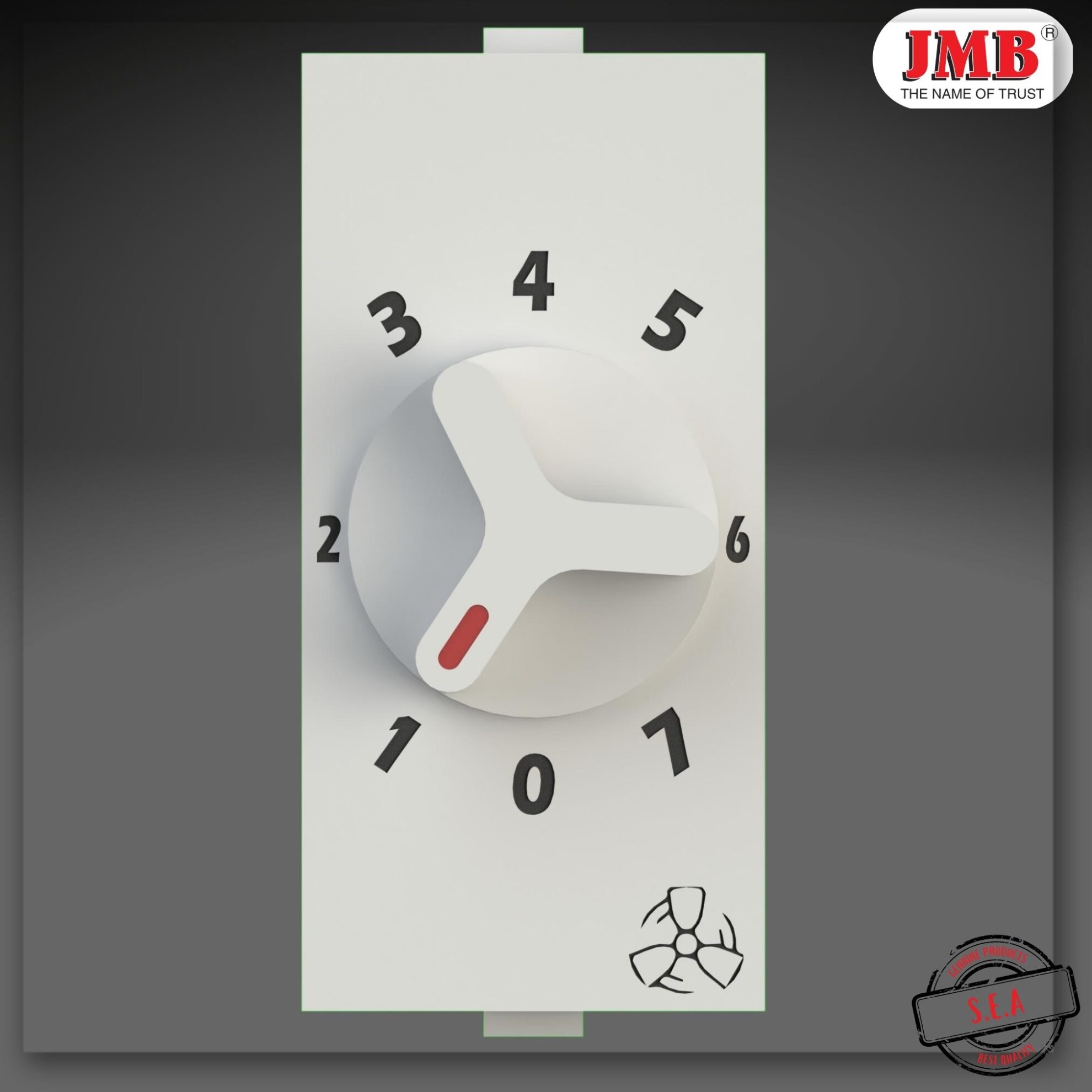
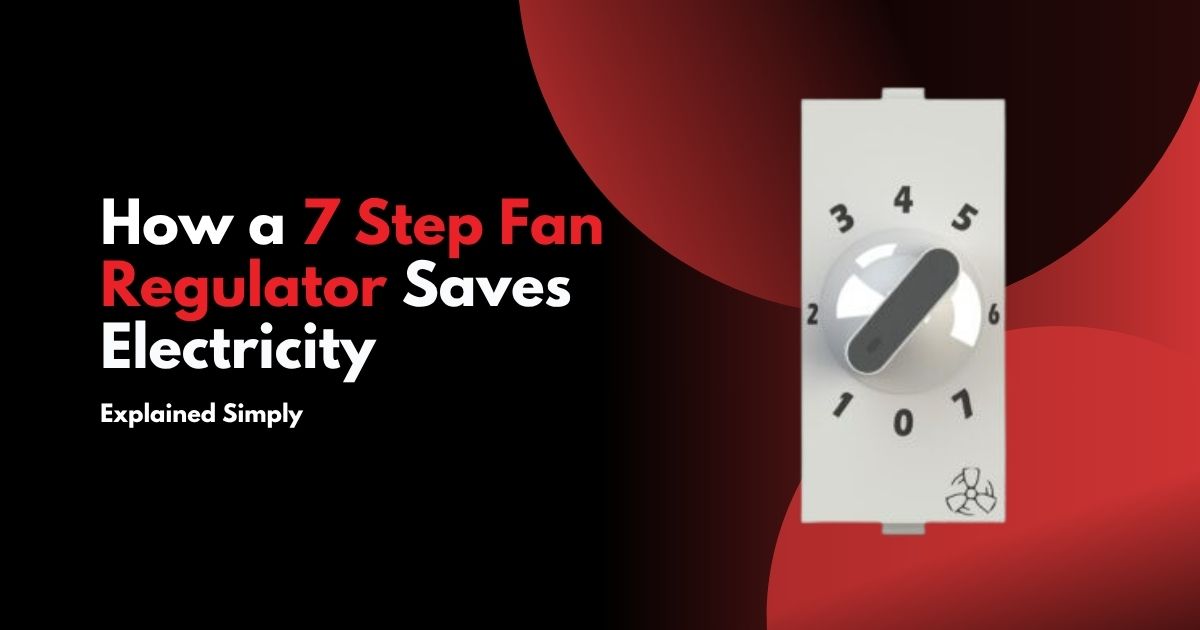
The energy-saving 1-module 7-step regulator fits a standard single-module switchboard space and delivers seven distinct speed levels with the low self-consumption typical of capacitor-type designs.
For those comparing 7-step products, the 7-step modular fan regulator is another option worth putting side by side before making a decision.
Compare the Right 7 Step Modular Fan Regulator Options
Choose the most energy-efficient regulator for your setup. Compare 1-module and 2-module 7 step modular fan regulator options designed to reduce electricity waste across residential, commercial, and bulk installations.
VIEW RANGE
Which Modular Regulator Is Right for Your Setup?
The right choice depends on your switchboard configuration, the number of modules available, and whether you prefer 5-step or 7-step speed control.
For a compact single-module space with 5-step control: The 2-module 5-step energy efficient regulator fits two-module openings and provides reliable step-based control with minimal self-consumption.
For a modern switchboard with space for a wider unit: The smart 2-module 5-step fan regulator offers the same capacitor-type performance in a contemporary design suitable for newer modular switchboard setups.
For users comparing 7-step options across brands: The 1-modular 7-step regulators category page lists the full range with specifications, which makes side-by-side comparison straightforward.
The complete product catalogue is available at the Sai Electronics product store for dealers, distributors and contractors placing bulk enquiries.
What Happens to an Old Resistance Regulator Over Time?
This is something many people overlook. A wire-wound resistance regulator does not perform consistently over its lifespan. The resistance wire inside the unit degrades with repeated heating and cooling cycles. Over time, the stated speed settings shift, the regulator runs hotter, and the wasted power increases beyond the original specification.
This means an old regulator that was already inefficient when new becomes progressively worse over the years. The electricity waste shown in the calculations above could be higher for a regulator that has been in service for five or more years without replacement.
Replacing it with a certified modular unit resets that efficiency curve from day one.
Is the Upgrade Cost Justified?
Here is a simple payback estimate based on the figures used earlier.
A quality BIS-certified modular fan regulator is typically available in the Rs. 150 to Rs. 350 range depending on the step count and module size. At an estimated monthly saving of Rs. 22 to Rs. 25 per fan, the payback period is roughly six to fifteen months per unit.
After payback, every additional month of operation represents a net saving on your electricity bill. For households, offices, hotels, and commercial spaces running multiple fans year-round, the cumulative saving over three to five years is significant.
For electricians and contractors specifying regulators for new installations or retrofits, choosing capacitor-type modular units from the outset eliminates the recurring inefficiency that resistance regulators introduce over time.
A Word on Accuracy and Real-World Variation
The calculations in this article use representative figures to illustrate the direction and approximate scale of potential savings. Your actual monthly saving from switching to a modular fan regulator will depend on:
- The rated wattage of your specific ceiling fan model
- The actual self-consumption of the regulator you are replacing
- The daily hours your fan operates and at which speed setting
- Your state electricity tariff, which varies significantly across India
The point of this exercise is not to give you a precise rupee figure to hold a manufacturer to. It is to show that the energy difference between regulator types is real, measurable, and financially meaningful when calculated across multiple fans and a full year of operation.
For Dealers, Distributors and Electrical Contractors
If you supply or install ceiling fans and regulators at scale, the product choice you make on behalf of your clients directly affects their long-term electricity costs. Sai Electronics India supplies BIS-certified modular capacitor regulators that are both a better technical recommendation and a stronger commercial proposition for repeat business compared to uncertified or resistance-type alternatives.
For bulk order enquiries, product specifications, or trade pricing, contact Sai Electronics for technical support and the team will assist with your requirements.
Summary
The financial case for switching from an old resistance regulator to a modern modular fan regulator is straightforward. Old wire-wound regulators waste between 15W and 25W as heat at low speed settings. Capacitor-type modular regulators waste 1W to 3W under the same conditions. Over a year, with multiple fans running daily, that gap adds up to a meaningful reduction in electricity costs.
The upgrade cost is modest, the payback period is short, and the performance benefit, quieter operation, consistent speed steps, and lower heat generation, makes the switch worthwhile independent of the electricity saving alone. If your home or commercial space still has wire-wound rotary regulators on the wall, replacing them one room at a time is one of the easiest efficiency improvements available without any major electrical work.
Frequently Asked Questions (FAQs)
Q1. Do all modern modular fan regulators save electricity?
Not all of them. Only capacitor-type step regulators (5-step or 7-step) save electricity at lower speed settings by shifting the electrical phase. If a modular regulator uses triac/dimmer-based electronics or older resistive wiring internally, it will still waste power and generate heat at low speeds. Always look for capacitor-based step regulators.
Q2. How much electricity does a fan regulator waste at full speed (Speed 5)?
Virtually zero. At full speed (Speed 5 or 7), the regulator bypasses the internal resistance or capacitor, supplying direct AC voltage to the fan motor. Power wastage only happens at lower speed settings (Speed 1 to 4) where the regulator has to drop or alter the voltage.
Q3. Will replacing an old regulator with a modular regulator reduce fan hum?
Yes! Old resistive or triac-based dimmer regulators chop the AC voltage waveform, which causes magnetic vibrations inside the fan motor—heard as a persistent humming sound. Capacitor-based modular regulators deliver a clean waveform, allowing the fan to run much quieter at low speeds.
Q4. Is a 7-step modular fan regulator better than a 5-step regulator for energy savings?
A 7-step regulator offers finer speed control, allowing you to run the fan at the exact comfort level you need without over-cooling the room. Since lower speed settings draw significantly less power, having more precise low-speed options can help you save a bit more electricity compared to jumping between broader 5-step speed gaps.
Q5. Can I install a modular fan regulator on a standard non-modular switchboard?
Standard modular regulators are designed to snap directly into modular switchboard plates. However, socket-type modular regulators or retrofit adapters are available that allow you to fit modern capacitor regulators into traditional wooden or non-modular switchboards without changing the entire board.
GET IN TOUCH
Not Sure Which Modular Regulator Saves the Most on Your Electricity Bill?
Whether you need a 5-step or 7-step modular unit, a single replacement, or bulk stock for a dealership or contracting business, our team can help you select the right model based on your fan wattage, usage pattern, and quantity requirements.
Contact Us