
How to Connect 2 Fan Regulators in a Single Switchboard: Complete Dual Regulator Wiring Guide
Having two fans in a single room is common in Indian homes, offices, hotel rooms, classrooms, and commercial spaces. However, fitting two fan regulators into a single switchboard can lead to space constraints, wiring confusion, and overloaded terminals if not planned correctly.
If you are an electrician, contractor, or a technically inclined homeowner planning a dual-regulator switchboard layout, this guide gives you the complete picture: module sizing, wiring logic, switchboard selection, and the safety steps that must not be skipped.
Important: Ceiling fan wiring involves live AC circuits. All work described in this guide must be carried out with the circuit switched off at the main distribution board. Where you are not confident about any step, have the work done by a licensed electrician. In commercial premises and rental properties, electrical work must comply with applicable local regulations.
Why Two Regulators in One Switchboard?
Installing both fan regulators in a single switchboard rather than two separate ones keeps the wall layout clean, reduces material cost, simplifies the conduit run, and makes it easier for occupants to control both fans from one point. In bedrooms, living rooms, and office cabins, this is often the preferred approach for both aesthetics and practicality.
The key challenge is selecting the correct module count, enclosure size, and wiring arrangement so both regulators operate independently without terminal conflicts.
Step 1: Understand Module Sizing Before You Begin
Every modular switchboard component occupies a certain number of modules. A standard single-module opening is approximately 25mm wide. When planning a dual-regulator switchboard, you need to count the total modules required across all components before selecting the enclosure.
Typical module counts for a dual-fan switchboard layout:| Component | Module Count |
| Fan regulator (1-module type) | 1 module each × 2 = 2 modules |
| Fan switch | 1 module each × 2 = 2 modules |
| Light switch (if included) | 1 module each |
| Blank plate / dummy plate | 1 module each |
Step 2: Choose the Right Switchboard Enclosure
Once the module count is confirmed, the enclosure needs to match. Surface-mounted boxes are the most practical choice for retrofits and additions because they do not require chasing into the wall.
For a 6 to 8 module layout covering two fans with regulators and switches, an 8-module horizontal surface box provides enough space with room to spare. The horizontal orientation suits wall positions where width is available and where the switchboard sits alongside a door frame or between two rooms.
Where wall space is more square than wide, the 8-module square surface box gives the same 8-module capacity in a compact square footprint. Both are suitable for housing two fan regulators, two switches, and additional components in a single enclosure.
For a broader view of enclosure options by size and shape, the modular surface box range lists all available variants.
Step 3: Plan the Module Layout Before Wiring
Before starting any wiring work, place the regulator and switch modules inside the enclosure without connecting any wires to ensure everything fits properly and the layout is convenient for the end user.
A logical layout for a two-fan switchboard:
[ Fan 1 Switch ] [ Fan 1 Regulator ] [ Fan 2 Switch ] [ Fan 2 Regulator ] [ Light Switch ] [ Blank ]
Label each position before wiring starts. This prevents cross-connection errors where the regulator for Fan 1 ends up controlling Fan 2. In a completed and plastered installation, correcting a cross-connection is significantly more work than getting it right the first time.
For installation guidance on fitting modular components into a surface enclosure, the article on modular surface box installation steps covers the assembly process clearly.
Compare the Right Modular Surface Box Options
Choose the correct enclosure size for your dual-regulator switchboard layout. Compare 8-module horizontal, square surface box, and open-body panel options designed for residential, commercial, and contractor installations.
VIEW RANGEStep 4: Understand the Wiring Concept for Dual Regulators
Each fan in the circuit operates on the same basic wiring principle: a live phase wire feeds the switch, the switched output goes to the regulator input, the regulator output goes to the fan motor live terminal, and the neutral goes directly from the neutral bus to the fan without passing through the switch or regulator.
For two fans on a single switchboard, the wiring concept looks like this:
Fan 1 Circuit: Mains Live → Fan 1 Switch (input) → Fan 1 Switch (output) → Fan 1 Regulator (line terminal) → Fan 1 Regulator (load terminal) → Fan 1 Motor (live) Neutral → directly to Fan 1 Motor (neutral)
Fan 2 Circuit: Mains Live → Fan 2 Switch (input) → Fan 2 Switch (output) → Fan 2 Regulator (line terminal) → Fan 2 Regulator (load terminal) → Fan 2 Motor (live) Neutral → directly to Fan 2 Motor (neutral)
Common connections in the switchboard: Both switches share the same incoming live feed. This is usually taken from a single entry point in the enclosure and looped across to both switch input terminals using a short link wire. The neutral bus inside the enclosure or at the ceiling rose handles the neutral distribution for both fans.
This arrangement allows each fan to have its own switch and independent speed control. Adjusting Regulator 1 has no effect on Fan 2, and vice versa.
Step 5: Select the Right Regulator for the Installation
The type of regulator you choose affects speed control performance, heat generation within the switchboard, and the long-term reliability of the installation.
For surface-mounted enclosures where heat dissipation is limited, a capacitor-type modular regulator is a better choice than a resistance-type unit. Resistance-type regulators generate considerably more heat during operation. In an enclosed surface box with two regulators running simultaneously, that heat buildup can shorten the life of both units and cause the enclosure to become warm to the touch.
For installations where the switchboard opening suits an open-body form factor, the open-body 7-step fan regulator provides 7-step speed control in a format that fits non-modular switchboard cutouts and dissipates heat more effectively due to its exposed body design.
An alternative open-body option with the same step configuration is the 7-step open body regulator unit, which suits installations where the regulator sits in a conventional switch plate opening rather than a modular frame.
For standard modular switchboard setups, either a 4-step or 5-step modular regulator in a 1-module or 2-module format will fit the layout described above. Match the module size to the space available in your chosen enclosure.
Featured Products
VIEW ALL ➔


Wiring Diagram: Two Fan Regulators in a Single Switchboard
Below is a text-based wiring diagram showing the complete dual-regulator switchboard circuit. Use this as a reference during installation.
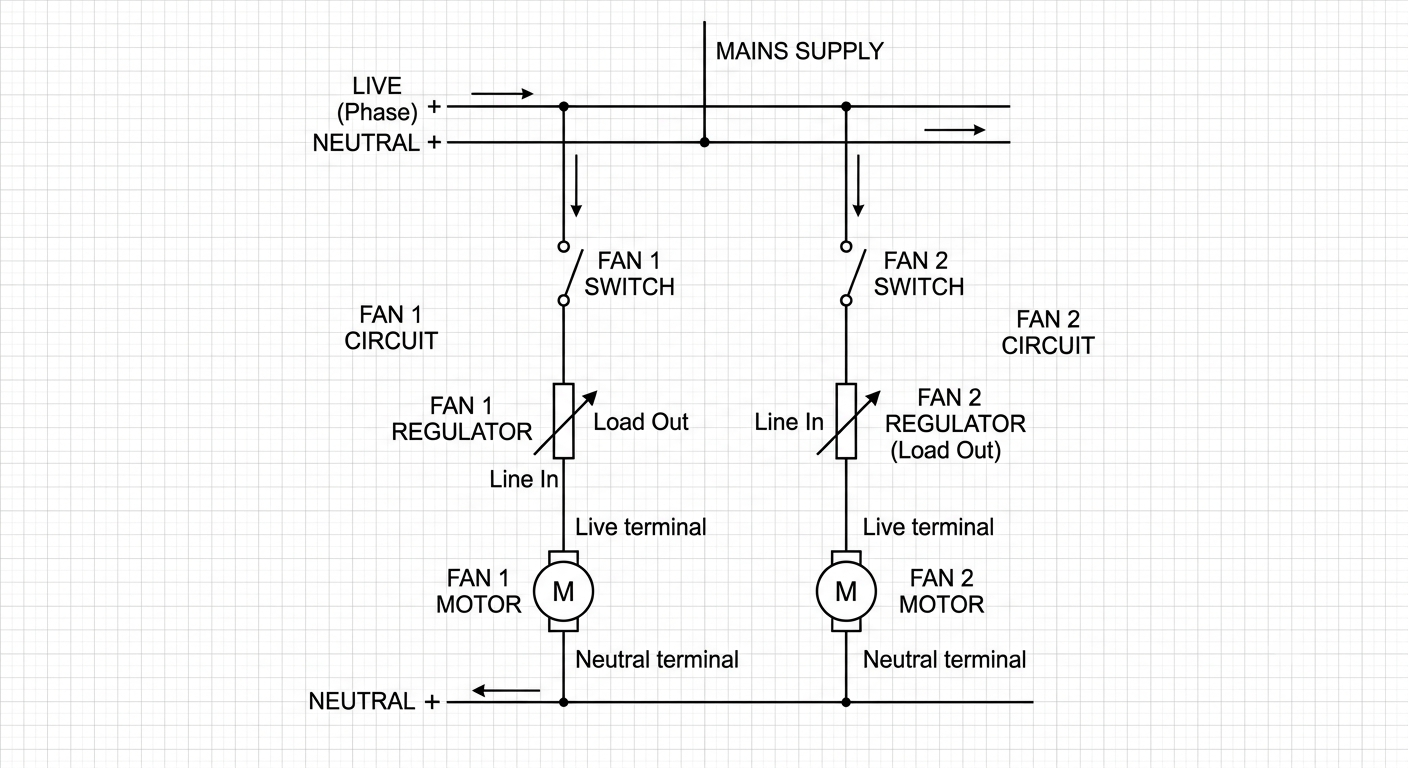
Key points from this diagram:
- The live feed enters the switchboard at a single point and is distributed to both switches.
- Each switch controls only its own fan and feeds only its own regulator.
- Neutral bypasses all switches and regulators and goes directly to the fan motor terminals.
- There is no shared connection between the two fan control circuits after the live entry point.
Common Wiring Mistakes to Avoid in Dual Regulator Setups
Mistake 1: Running neutral through the switch or regulator Neutral must go directly to the fan motor. Routing it through the switch creates a shock hazard. Routing it through the regulator terminals interferes with speed control function.
Mistake 2: Sharing output terminals between two regulators Each regulator must have its own dedicated load output wire going to its specific fan. Never combine the output of two regulators on a single terminal.
Mistake 3: Using mismatched regulator types in the same enclosure If one regulator is a resistance type and the other is a capacitor type, the heat generated by the resistance unit can affect the capacitor regulator's performance over time. Use matching types in a shared enclosure wherever possible.
Mistake 4: Undersizing the enclosure Forcing two 2-module regulators into a 6-module box leaves no room for switches or cable management. Measure the total module requirement including all components before selecting the enclosure.
Mistake 5: Not labelling circuits before closing the switchboard Once the enclosure has been closed and mounted on the wall, identifying individual wire connections becomes much more difficult. Label each wire at both ends before closing up.
Electrical Safety: Non-Negotiable Steps
Work on fan wiring only after confirming these steps:
- Switch off the specific circuit at the main distribution board, not just at the wall switch.
- Use an insulated phase tester to verify that no live voltage is present at the switchboard before opening any terminal.
- Do not work on live circuits. There is no safe way to wire a regulator terminal while the circuit is energised.
- In commercial buildings, schools, hotels, and rented premises, all electrical work must be carried out by a licensed electrician in compliance with applicable local standards.
- After completing the wiring, have a second person verify the connections against this guide before switching the circuit back on.
If you are unsure at any stage of the installation, consult a qualified electrician before proceeding. The cost of a professional visit is far lower than the cost of correcting a wiring fault after the switchboard has been closed and the circuit has been energised incorrectly.
For Electricians and Contractors: Bulk Supply
If you regularly install dual-fan switchboards in residential projects, commercial fit-outs, hotels, or institutional buildings, sourcing consistent and certified regulator and enclosure components in bulk keeps your job quality uniform and reduces on-site delays caused by last-minute product substitutions.
BIS-certified modular regulators and properly rated surface enclosures from Sai Electronics India give you components that perform consistently across installations and reduce callbacks from clients reporting faults after handover.
The complete range of regulators and modular enclosures is available at the Sai Electronics product store. For bulk order enquiries, trade pricing, and technical support on specific project requirements, contact Sai Electronics for technical support and the team will assist with your needs.
Summary
Fitting two fan regulators into a single switchboard is a straightforward task when the module sizing is correct, the enclosure has enough space, and the wiring keeps each fan circuit fully independent. The key principles are consistent across every installation: live enters through the switch, passes through the regulator, and reaches the fan motor. Neutral bypasses both the switch and the regulator entirely.
Plan the layout before wiring, choose an enclosure with room to spare, use capacitor-type modular regulators to keep heat generation low inside the box, and never work on a live circuit. When installed correctly, a dual-regulator switchboard provides a neat and practical way to control two ceiling fans independently from a single location.
Frequently Asked Questions (FAQs)
Q1. Can I connect two fan regulators to a single speed switch?
No. Connecting two regulators to a single switch means both fans will turn on/off together and can create uneven load distribution. Always use a dedicated switch for each fan so both regulators can function independently without overloading the switch terminals.
Q2. What happens if I accidentally interchange the Line (In) and Load (Out) wires on a fan regulator?
In most standard capacitor-type step regulators, interchanging the Line In and Load Out wires will not damage the regulator or fan because it operates as a simple inline series element. However, following the correct manufacturer markings (Line to switch, Load to fan) ensures proper safety standards and clean wiring.
Q3. Is it safe to put two fan regulators inside a compact 4-module or 6-module switchboard?
It depends on the heat generation. If you are using modern capacitor-type modular regulators, heat generation is minimal, so fitting them in a compact box is generally safe. However, using older resistance-type regulators in a tight, unventilated enclosure can cause severe heat buildup, damaging the internal wiring and shortened component life. Always prefer capacitor regulators for dual setups.
Q4. Why is my second fan humming when both regulators are on the same switchboard?
If one or both regulators are triac-based dimmers, electrical noise and frequency distortion can travel through the shared live wire inside the switchboard. Upgrading both regulators to capacitor-based step regulators isolates the waveform and eliminates cross-interference humming.
Q5. Can I use a 2-module regulator and a 1-module regulator together in the same switchboard?
Yes, as long as your switchboard frame has enough total module space. For example, a 2-module regulator, a 1-module regulator, two fan switches, and a light switch require a minimum 6-module switchboard layout.
Not Sure Which Regulator and Switchboard Setup Fits Your Project?
Whether you need modular, open-body, or surface-box regulators for a single installation or bulk procurement, our team can help you select the right model based on your panel type, application, and quantity requirements.
Contact UsBlog Categories
- 4 Step Fan Regulator
- 5 Step Fan Regulator
- 5 Step Fan Regulator Manufacturer
- 7 Step Fan Regulator manufacturer
- Blogs
- cooler regulator manufacturer
- fan dimmer manufacturer
- fan plate cover manufacturers
- Fan Regulator Manufacturing
- Fan Sheet manufacturer
- LED Foot Lights manufacturer
- modular blank plate manufacturer
- rotary dimmer manufacturer
- Surface box manufacturing
- USB Socket Manufacturers
